What happened · Homelite
What Happened to Homelite Chainsaws?
From generators in Port Chester, New York, to the 12-pound XL-12 and three million saws, then Textron, John Deere and a Hong Kong toolmaker. Where the Homelite name ended up.
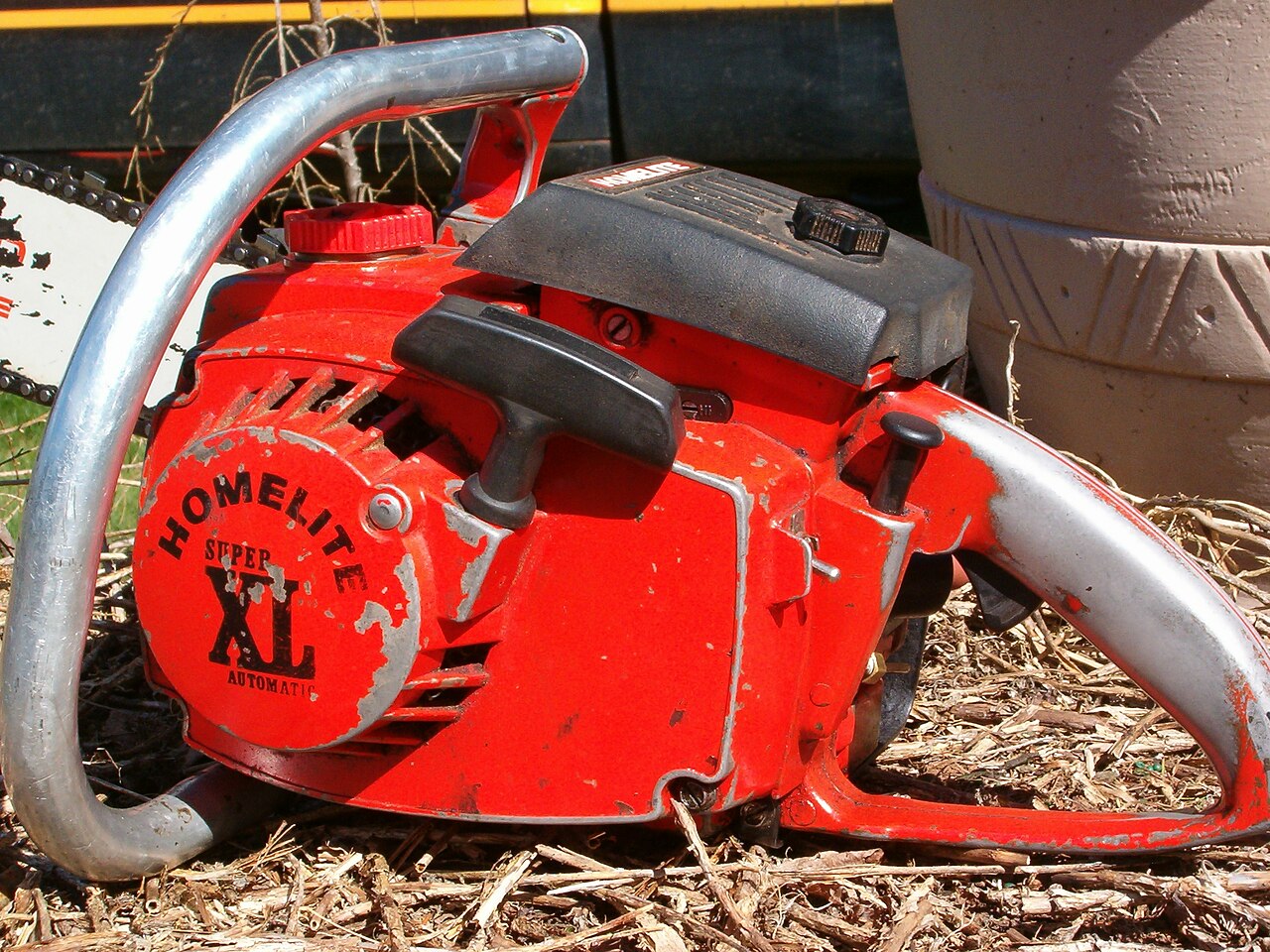
- Founded
- 1921, Port Chester, New York
- Famous model
- XL-12 (1963), 12 lb without bar and chain
- Owners
- Textron (1950s-1994), John Deere (1994-2001), Techtronic Industries (since 2001)
- Today
- A TTI brand, sold alongside Ryobi and Milwaukee
Ownership timeline
- 1921Homelite starts in Port Chester, New York, making small portable generators
- 1955Becomes a division of Textron (by September 1956 at the latest)
- 1957Gastonia, North Carolina chainsaw plant dedicated on 25 November
- 1963The XL-12 reaches dealers in November
- 1971Homelite builds its three millionth chainsaw
- 1994Deere & Company buys Homelite from Textron for about $120 million
- 2001Deere exits; Techtronic Industries agrees to buy the Homelite brand
A generator company that built a saw
Homelite started in Port Chester, New York, as a maker of small portable gasoline generators. The name came from Home Electric Lighting Co., and the founder, Charles H. Ferguson, is described as a retired engineer. Textron's 1971 annual report says Homelite celebrated its 50th year that year, which puts the start in 1921.
The first Homelite saws ran off those generators. A 1948 Homelite advertisement in Construction Methods told crews to use the "Homelite Chain Saw with a Homelite Dual Purpose Generator".
The man most tied to the saw was J. Allan Abbott. He joined as a salesman at the start of the Depression, was president from 1941, and became chairman in 1969. When he died at Boca Raton, Florida, in November 1982, the New York Times called him "a developer of the one-man chain saw".
The Ferguson family sold the company to Abbott, and by September 1956 the New York Times was calling Homelite "a division of Textron". Two sources give 1955 as the year Textron took it over.
From 27 pounds to 7
The story of Homelite saws is a story of weight. Each new saw was lighter than the one before it, and each one reached a new kind of buyer.
| Year | Saw | Weight, as advertised or reported |
|---|---|---|
| 1952 | 4-horsepower Homelite chain saw | 27 pounds |
| 1963 | XL-12 | 12 pounds, without bar and chain |
| 1969 | E-Z | 8 1/2 pounds |
| 1972 | XL-2 | 7 pounds |
The 1952 figure comes from an Engineering News-Record advertisement and a dealer ad in the Dixon Evening Telegraph. The E-Z and XL-2 weights come from Textron's own annual reports.
The XL-12
The XL-12 reached dealers in November 1963. On 16 November the Gettysburg Times reported that the Adams County Fruit Packing and Distributing Co. in Biglerville, Pennsylvania, had the "revolutionary new Homelite XL-12" in stock. A company official called it "the greatest advance in chain saw design and construction in the last decade". A week later an advertisement in the Monroe Morning World of Louisiana called it the the "World's Lightest Direct Drive Saw".
Homelite's August 1964 advertisement in Weeds and Turf listed what owners got:
- 12 pounds, less bar and chain
- cuts through 12-inch logs in 10 seconds
- Homelite short-stroke engine
- all-position diaphragm carburetor and "hot-spark" ignition
- automatic clutch and safety throttle
- die-cast construction, with the ignition switch, chain oiler, choke and throttle grouped for one-hand use
By November 1964 a "Super XL 12" was already turning up in newspaper classifieds. The weight depends on who was counting: 12 pounds bare in Homelite's launch ads, 14 pounds with a 12-inch bar and chain in a 1963 dealer notice, and 13 3/4 pounds dry in a 1974 dealer ad.
Gastonia and three million saws
On 25 November 1957 Homelite dedicated a new chainsaw plant in Gastonia, North Carolina. The New York Times reported a 145,000-square-foot building that cost 2.5 million dollars, a capacity of more than 100,000 saws a year, and plans to employ 600 people. Textron chairman Royal Little spoke, Governor Luther B. Hodges praised the plant, and the first truckload of saws left the line that day. Generators and pumps stayed in Port Chester. Gastonia city directories from 1967 to 1980 list "Homelite (A Division of Textron Inc)" at 3600 Little Mountain Road.
In May 1971 Homelite made its three millionth chainsaw. Textron's 1971 annual report said it was the first maker to reach that number, and put Homelite among Textron's top ten profit contributors.
Textron's 1969 report explains where those sales came from. The light E-Z saw was "a particular success, carrying further the development of the occasional user market pioneered by Homelite several years ago". In other words, Homelite had helped turn the chainsaw from a logger's tool into something a homeowner kept in the garage. The 150 Automatic of 1971 and the XL-2 of 1972 were aimed at the same buyers.
Why Homelite disappeared
There was no single blow. Several things came together over about twenty years.
The cheap end filled up. The occasional-user market Homelite had opened attracted everyone. A 1979 Justice Department complaint described these saws as "of a lighter weight, less durable and less expensive type", and named Beaird-Poulan, maker of the Poulan Micro 25, as the leader of that segment in 1977 with 23 percent.
The firewood boom ended. The Consumer Product Safety Commission said in 1980 that roughly three million chainsaws were sold in the United States each year. Trade magazine Lawn & Garden Marketing reported in June 1983 that shipments had peaked at 3.7 million in 1979 and fallen to 1.4 million gasoline saws in 1982, a drop it put at 54 percent. In the same years Stihl's volume, sold through servicing dealers, grew 113 percent.
Safety and emissions rules added cost to every saw. The CPSC began work on a mandatory kickback rule in 1980, then withdrew it in August 1985 in favour of a voluntary industry standard that called for at least two kickback-reduction features, such as low-kickback chain or a chain brake. Homelite answered with its Safe-T-Tip device. In 2000 the EPA set Phase 2 emission limits for handheld engines, phased in from model year 2002, and estimated the cost at "$20 to $56 for individual units".
The new owner lost money. In August 1994 Textron sold Homelite to Deere & Company for about 120 million dollars. Deere's filings show its hand-held consumer products business losing money:
| Deere fiscal year | Hand-held revenues | Pretax operating loss |
|---|---|---|
| 1999 | $317 million | $13 million |
| 2000 | $235 million | $70 million |
| 2001 | $240 million | $72 million |
Deere blamed "costs and inefficiencies" and "weaker market conditions". In late August 2001 it announced it would leave the business, affecting about 700 employees, mainly in the southeastern United States and Mexico, and sell its plant in Chihuahua. Deere did not say the emissions rules caused the exit, and we do not claim they did.
Who owns Homelite today
In November 2001 Techtronic Industries of Hong Kong agreed to buy the Homelite brand of consumer outdoor products from Deere, including the Mexican plant. TTI's 2002 interim report said Homelite was being combined with Ryobi, and that TTI would spend about 20 million US dollars on a combustion-engine plant in China for both brands. In 2004 TTI agreed to buy Milwaukee Electric Tool and AEG for 713 million dollars.
By 2008 the arrangement was plain on a recall notice. On 30 October 2008 the CPSC announced a recall of about 370,000 Homelite chainsaws because the chain brake could fail to stop the chain on first application. They were imported by Homelite Consumer Products of Anderson, South Carolina, made in China, and sold at Home Depot from December 2007 to October 2008 for 110 to 200 dollars. No injuries were reported.
TTI's 2024 annual report still lists Homelite among its brands, behind its two flagships, Milwaukee and Ryobi. In November 2026 homelite.com was selling chainsaws, blowers, string trimmers and hedge trimmers.
If you still have an old Homelite
Start with the model name and serial number on the saw itself. XL-12, Super XL, Super XL Automatic and XL-2 are different saws, and parts listings are organised by model. The parts box on this page searches the Internet Archive and eBay by model.
Homelite's great rival at the cheap end has its own story: What Happened to Poulan Chainsaws?.
Quick questions
Is Homelite still in business?
Yes, as a brand. Techtronic Industries (TTI) of Hong Kong owns it, lists it among its brands in its 2024 annual report, and homelite.com still sells chainsaws, blowers, string trimmers and hedge trimmers.
Who owns Homelite?
Techtronic Industries, the company behind Ryobi and Milwaukee. TTI agreed to buy the Homelite brand from Deere & Company in November 2001. Before that, Homelite belonged to Deere from 1994 and to Textron from the mid-1950s.
Where were Homelite chainsaws made?
The first saws came from Port Chester, New York. From 1957 the chainsaws were built at a plant in Gastonia, North Carolina, on Little Mountain Road. Under Deere there was also a plant in Chihuahua, Mexico, and the saws recalled in 2008 were made in China.
How much does a Homelite XL-12 weigh?
Homelite's 1963-64 advertisements said 12 pounds without the bar and chain. A 1963 dealer notice gave 14 pounds with bar and chain, and a 1974 dealer ad said 13 3/4 pounds dry, less bar and chain.
Was there a Homelite chainsaw recall?
Yes. On 30 October 2008 the Consumer Product Safety Commission announced a recall of about 370,000 Homelite chainsaws sold at Home Depot from December 2007 to October 2008, because the chain brake could fail to stop the chain on first use. No injuries were reported.
Sources
- Textron annual reports (1969 to 1974) and Form 10-K (1993, 1994)
- Deere & Company Form 10-K (1994, 1995, 1997, 2000, 2001, 2002)
- Techtronic Industries interim report (2002) and annual report (2024)
- New York Times (6 September 1956, 26 November 1957, 23 November 1960, 7 January 1969, 7 May 1971, 17 March 1981, 27 November 1982, 22 July 1994, 28 August 2001, 31 August 2004)
- Engineering News-Record (March 1952)
- Dixon Evening Telegraph (2 April 1952)
- Gettysburg Times (16 November 1963)
- Monroe Morning World (23 November 1963)
- Weeds and Turf (August 1964)
- The American City (April 1958)
- Gastonia city directories (1967 to 1980)
- Lawn & Garden Marketing (June 1983)
- U.S. Consumer Product Safety Commission releases (20 June 1980, 1985, 30 October 2008)
- U.S. v. Emerson Electric and Skil, Justice Department complaint (22 March 1979)
- EPA Phase 2 handheld engine rule, 65 FR 24268 (25 April 2000)
- homelite.com (November 2026).
Every fact on this page comes from these sources. Where sources disagree we say so. Tell us if something is wrong and we will correct it and note the change.