What happened · Chevrolet
What Happened to the Chevy LUV?
The small Chevrolet pickup built by Isuzu in Japan, shipped in two pieces to dodge a 25 percent tariff, outsold by the S-10, and ended by 600 rusted trucks crushed on a Tampa dock.
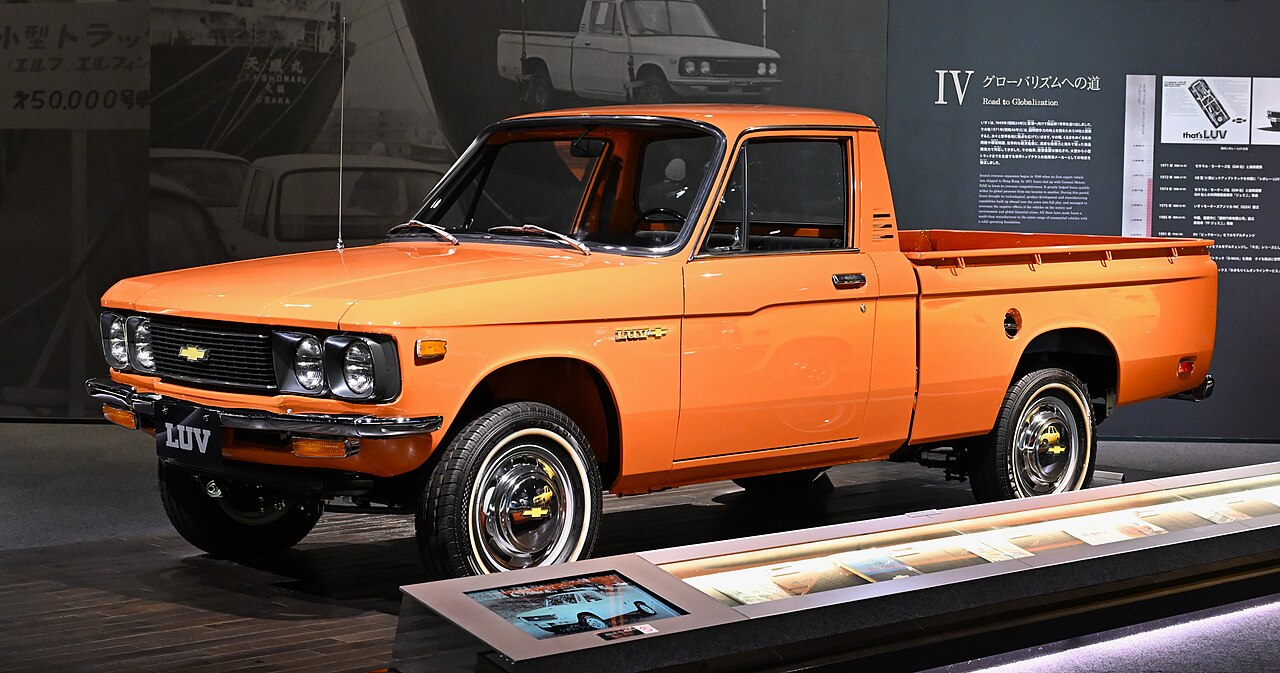
- Built by
- Isuzu Motors, Fujisawa, Japan
- Sold by Chevrolet
- 1972 to 1982
- Best year
- 100,192 sold in 1979
- Engine (1972)
- 1.8-litre overhead-cam four, 75 hp
Timeline
- 1971GM buys about 34 percent of Isuzu
- 1972LUV goes on sale at West Coast Chevrolet dealers in March
- 1979Record year: 100,192 sold
- 1980Import duty on the cab-chassis rises to 25 percent in August
- 1982The American-built S-10 takes over; last LUV model year
- 1983About 600 unsold LUVs crushed in Tampa
- 2006GM sells its last Isuzu shares
The Chevrolet with "MADE IN JAPAN" on the door
The tailgate said CHEVROLET in raised block letters, painted black on every color. The plate in the door jamb said "MFD BY ISUZU MOTORS LTD" and "MADE IN JAPAN". GM's 1972 specifications book codes the assembly plant in the VIN as Fujisawa.
LUV stood for Light Utility Vehicle. GM had bought about 34 percent of Isuzu in 1971; chairman James Roche signed the agreement in Tokyo on 16 July 1971. On 18 March 1972 GM chairman Richard Gerstenberg announced that Isuzu-built pickups would go on sale through selected Chevrolet dealers on the West Coast the following week.
Popular Science explained why GM did not build a small truck at home: its small-car plants were running at capacity and their unit bodies did not suit trucks. "The answer was to buy them in Japan."
What the 1972 LUV was like
- Engine: Isuzu 1.8-litre (110.8 cubic inch) overhead-cam four, two-barrel carburettor, 75 horsepower and 88 lb-ft
- Gearbox: four-speed manual
- Brakes: drums with power assist as standard
- Front suspension: independent, with torsion bars; leaf springs at the back
- Bed: about six feet long, all-steel, with eleven wire hold-down eyes and a tailgate held by two chains, with separate latches on each side
- Cab: two seats; the transmission tunnel made three-abreast impossible
Popular Science timed it at 21.4 seconds from 0 to 60, called the oval instruments "weird", and noted the heater controls were hidden if you used the ashtray. In a 1974 Popular Mechanics survey owners averaged 21.5 miles per gallon, named the rough ride as their top complaint, and 76.1 percent said they would buy another. One North Carolina fleet foreman wrote: "The Luv is built just like the trucks of the 1950s."
The spare tire hung under the bed on a chain, lowered with the jack handle through a hole in the rear panel. The optional Mikado package added a three-spoke wheel, bright upholstery and carpet.
The truck that crossed the ocean in two pieces
Since the 1963 "chicken war", a complete imported light truck paid a 25 percent duty. A cab and chassis paid only about 4 to 5 percent.
The LUV was built to fit that gap. GM's 1972 specifications book orders the trucks "shipped in two major component parts": cab-chassis units without beds, and pickup boxes "in shipping packs", six boxes of one color to a pallet, four packs to a 40-foot container. The gas filler neck and all the rear lights travelled in the box pack. A temporary customs "incomplete vehicle" notice was stuck inside the windshield. The bed, mirrors and some options were fitted in the United States.
The Ford Courier and Japanese-brand pickups were imported the same way. In May 1980 the U.S. Customs Service ruled that a cab-chassis without its bed was an unfinished truck, dutiable at 25 percent, from 21 August 1980. Automotive News estimated the change would add 600 to 900 dollars to the price of a LUV or a Courier.
LUV sales by year
| Year | LUVs sold | Note |
|---|---|---|
| 1972 | about 21,000 | first year, from late March |
| 1978 | 67,035 | then a record |
| 1979 | 100,192 | best year ever, up 49.5 percent |
| 1980 | 88,447 | duty rises in August |
| 1982 | about 22,300 | S-10 on sale |
In 1979 the LUV was the third best-selling imported light truck by registrations, behind Toyota and Datsun.
What a LUV cost new
Chevrolet's price pages list the truck "at point of entry", before destination charges and dealer-installed options.
| Model year | Two-wheel drive | Four-wheel drive |
|---|---|---|
| 1976 | $3,284.35 | not offered |
| 1979 | $4,276.35 (6-ft bed) | $5,989.10 |
| 1982 | $5,941.35 | $7,865.10 |
In 1979 the Mikado trim cost $199 with a bench seat or $310 with buckets, and air conditioning $525.
Why the LUV disappeared
The usual answer is "the S-10 replaced it". That is true, but the S-10 was itself the result of rules written years earlier.
On 12 December 1977 NHTSA, under administrator Joan Claybrook, proposed light-truck fuel-economy rules that limited how far "captive import" trucks, built abroad for American companies, could count toward a carmaker's domestic average. The notice said one purpose of the law was "to encourage the domestic production of automobiles which are currently imported by the major domestic automobile companies", and that the standards from 1982 would assume GM, Ford and Chrysler sold small pickups built in the United States. Separate counting of captive imports took effect from the 1980 model year.
So from 1980 a fuel-efficient LUV no longer helped GM's domestic truck average, and from August 1980 it paid 25 percent duty. In December 1980 Automotive News reported that GM's new S-10, to be built in Shreveport, Louisiana, and Dayton, Ohio, would "eventually replace the LUV". Chevrolet's general manager, Robert Lund, said each LUV model would be dropped as the matching S-truck arrived.
The S-10 went on sale for 1982. In the first three months of 1982 Chevrolet sold 8,826 LUVs against 23,905 a year before; its truck sales manager said the drop was "anticipated". The S-10 sold 177,758 that year. The 1982 LUV, offered with gas or a 2.2-litre Isuzu diesel, was the last.
600 new LUVs crushed in Tampa
About 600 unsold 1982 LUVs sat on a low dockside lot in Tampa, Florida, waiting for East Coast dealers who no longer wanted them. After heavy rain, inspectors found severe rust underneath. In December 1983 GM had them crushed into nine-inch chunks and shredded. They were worth about 5 million dollars. A Chevrolet spokesman said selling them cheaply would "jeopardize Chevrolet dealer integrity", and that selling the parts would cost more than destroying the trucks.
After the LUV
From 1981 Isuzu sold its own version of the truck, the Isuzu P'up, through its own American company, with the same diesel engine as the LUV. GM kept part of Isuzu for 35 years and sold its last 7.9 percent in April 2006. One of the buyers was Itochu, the new name of C. Itoh & Co., the trading house whose managers had signed the LUV's 1972 specifications book. Captive-import trucks faded out: by 1994 neither GM nor Ford sold any. The 25 percent duty on imported light trucks is still in force.
If you have a LUV, search for parts with the VIN and the model details on the door plate, and say which year: the LUV changed through the 1970s, and the last models came in gas and diesel versions.
Quick questions
What does LUV stand for?
Light Utility Vehicle. Popular Science and Popular Mechanics both spelled it out in the 1970s, and GM's own 1972 specifications book codes the L in the model number as "Light Utility".
Who made the Chevy LUV?
Isuzu Motors of Japan. GM bought about 34 percent of Isuzu in 1971, and the door-jamb plate on the truck read "MFD BY ISUZU MOTORS LTD" and "MADE IN JAPAN".
When did Chevrolet stop selling the LUV?
The last LUVs were 1982 models. Chevrolet's own S-10, built in Shreveport, Louisiana, and Dayton, Ohio, replaced it, and dealers were still selling leftover new 1982 LUVs in 1983.
What engine is in a Chevy LUV?
The 1972 LUV had an Isuzu 1.8-litre overhead-cam four with a two-barrel carburettor, rated 75 horsepower, and a four-speed manual. A 2.2-litre Isuzu diesel was offered in the last years.
Why were Chevy LUVs shipped without a bed?
A complete imported pickup paid a 25 percent duty after 1963, but a cab and chassis paid about 4 to 5 percent. The LUV crossed the Pacific as a cab-chassis with its cargo box packed separately, and was finished in the United States. Customs closed that route in 1980.
Sources
- GM Chevrolet LUV General Specifications Books (1972, 1976, 1979, 1982)
- Popular Science road test (July 1972)
- Popular Mechanics owners' survey (March 1974)
- New York Times (November 1970 to March 1972, June 1979, February 1982, June 2004)
- Automotive News (1980 to 1984, including the 1984 Market Data Book)
- Christian Science Monitor (17 June 1980, 27 April 1981)
- Advertising Age (June 1982)
- UPI (8 December 1983)
- Toyota Motor Sales v. United States, 585 F.Supp. 649 (Court of International Trade, 1984)
- Foreign Relations of the United States 1977-80 vol. III doc. 245 (30 June 1980)
- NHTSA proposed rule 42 FR 63184 (15 December 1977) and final rule 59 FR 16312 (6 April 1994)
- 49 CFR 533.5
- GM Form 8-K (11 April 2006)
- Edmunds and LUV owner club history pages for 1972 sales.
Every fact on this page comes from these sources. Where sources disagree we say so. Tell us if something is wrong and we will correct it and note the change.